Order a whole fish in Spain or in Thailand and it often arrives the same way: head on, tail on, put in the middle of the table to share. After that the two kitchens go in different directions. In the Spanish dishes below, the fish is kept fairly plain, with oil, garlic and salt doing the work. In the Thai dishes, the flavour goes into the sauces and herbs that come with it. Salt plays a big part in both, which makes the two easy to compare.
Pescado a la sal: baked in a salt crust
Pescado a la sal is one of the simplest dishes in Spanish coastal cooking. A whole fish, usually dorada (gilthead bream) or lubina (sea bass), is gutted but left with its scales, then buried in a thick layer of coarse salt, sometimes mixed with a little water or egg white so it sets. It goes into a hot oven until the crust is hard.
At the table the crust is cracked open and lifted off, the skin is peeled back and the fish is served in pieces. The salt is not eaten. The skin and scales keep it out, so the flesh steams in its own juices and comes out moist, seasoned but not salty. It is usually served with a drizzle of olive oil, and sometimes an alioli on the side.
Other ways Spain serves a whole fish
- A la espalda: the fish is opened flat along the back and grilled or cooked on the plancha, then finished with a refrito of olive oil, sliced garlic and guindilla chilli, often with a splash of vinegar. It is a Basque way of cooking besugo (sea bream), lubina or rodaballo.
- A la parrilla: grilled whole over embers. Getaria, on the Basque coast, is known for grilled fish such as rodaballo (turbot), cooked in a hinged grill basket.
- Espetos: on the beaches of Málaga, sardines are threaded on a stick and cooked beside an open fire, often built in an old boat filled with sand.
- Al horno: baked in the oven, often on a bed of sliced potatoes. Baked besugo is a traditional Christmas Eve main in Madrid, which our Spanish Christmas food guide covers.
Small fish are a different story. In Andalusia they are dusted in flour and fried whole as pescaíto frito; our Andalusian food guide explains what to order.
Pla pao: grilled in a salt coat
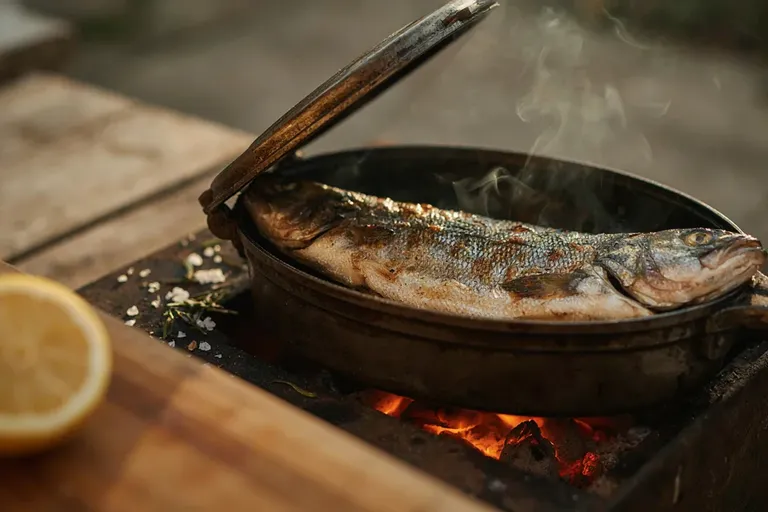
Pla pao is the Thai salt-grilled fish you see on street grills and in markets. The fish, often tilapia (pla nin) or snakehead (pla chon), is stuffed with lemongrass and pandan leaves, rubbed all over with salt and grilled slowly over charcoal. The salt dries into a white crust on the skin, which keeps the flesh moist.
As with the Spanish version, you don't eat the salty skin. You peel it back and pick out the flesh, then eat it with nam jim seafood, the sour, spicy dipping sauce made with lime, garlic, chilli and fish sauce. It often comes with rice noodles, fresh herbs and leaves for wrapping.
Other ways Thailand serves a whole fish
- Pla nueng manao: whole fish, often sea bass (pla kapong), steamed and served in a sharp broth of lime juice, garlic, chilli and fish sauce. Restaurants often bring it in a fish-shaped tray over a small burner so it stays hot.
- Pla rad prik: the fish is deep-fried whole until crisp, then covered in a sweet, sour and spicy chilli sauce.
- Pla tod: simply deep-fried, served with a dipping sauce or a green mango salad.
How they compare
The salt technique is close. In both, the fish is cooked whole with its skin on and the salt acts as a shell that holds in moisture. The Spanish crust is thicker and the fish is baked; the Thai coat is thinner and the fish is grilled over coals, so the skin picks up smoke.
The real difference is what happens after cooking. The Spanish dishes above usually arrive with olive oil, garlic or lemon and little that hides the taste of the fish. The Thai dishes above usually come with a sauce, broth or salad that brings sourness, heat or both, and the fish is commonly eaten as one dish among several with rice. If you like the Thai way, ask for alioli or a refrito in Spain. If you like the Spanish way, pla pao with the sauce on the side is the closest match.
Ordering a whole fish
- Ask the price first. In Spain a whole fish is often sold by weight, and the menu may say S/M (según mercado, market price). Our post on seafood by weight explains how that works in both countries.
- Ask how many it serves, and compare the total with ordering separate portions.
- Ask whether they will fillet it. Some restaurants will debone a whole fish for you, at the table or in the kitchen, if you ask.
Where to try fish dishes
These venues mention fish dishes in their own records on our site.
- Txikito, New York: a Basque restaurant in Chelsea whose listing names whole fish alongside pintxos and crispy suckling pig.
- Parrillan Borough Yards, London: cooks Spanish produce on a wood-fired grill, with whole fish, Galician steaks, arroces and seasonal vegetables on its list.
- Restaurante Emilio, Mexico City: its record names boiled sea bass with prawns and saffron among its dishes, in a kitchen inspired by Basque cooking with Mexican and French influences. The record doesn't say whether the fish is served whole.
For more Spanish and Thai seafood, see our posts on gambas and goong and calamares and pla muk.