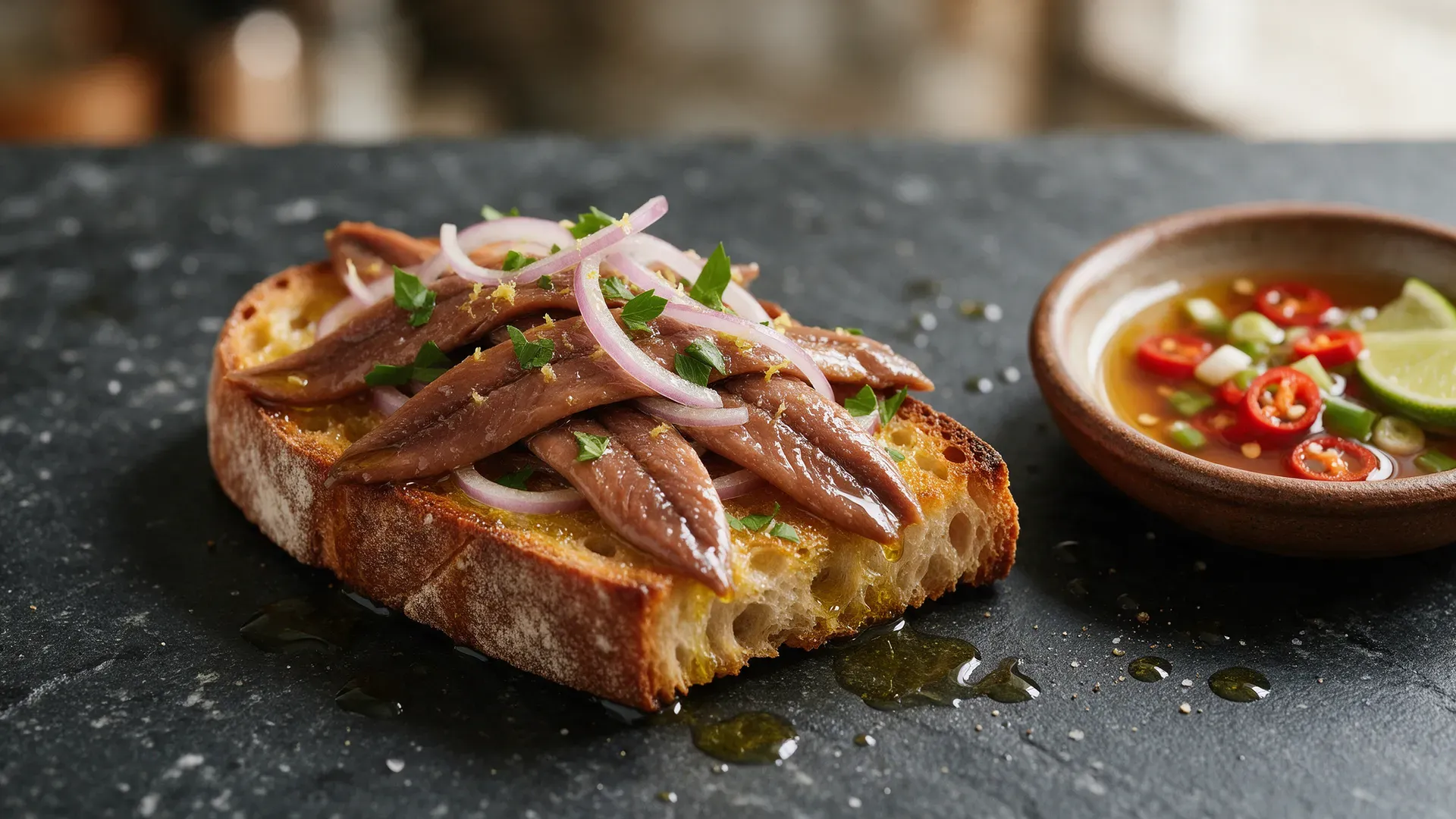
Put a tin of Cantabrian anchovies next to a bottle of Thai fish sauce and they look like they have nothing in common. One is a row of silver-brown fillets in olive oil. The other is a clear amber liquid. Both usually start in the same place: small oily fish, a lot of salt, and months of waiting.
For Thai diners trying Spanish food, and for Spanish food lovers in Thailand, anchovies are one of the easiest bridges between the two kitchens.
The Spanish way: eat the fish
Spain eats its anchovies as fish, in two main forms, and it helps to know which one you're ordering.
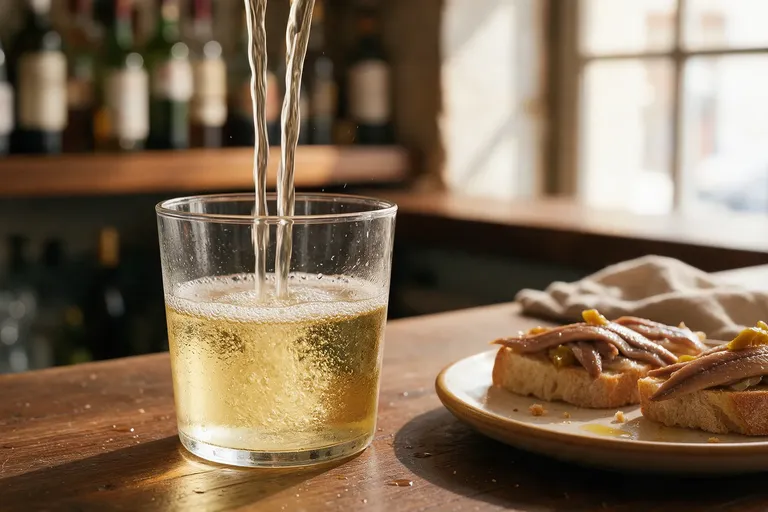
Anchoas are salt-cured. The best known come from the Cantabrian coast, with the town of Santoña as the traditional centre. Fresh anchovies are layered with salt and left to cure for months, then cleaned by hand, filleted and packed in olive oil. The result is dark, firm and intensely savoury. Good ones taste of the sea rather than of harsh salt. They are served on bread, sometimes with butter or tomato, or threaded onto a gilda with an olive and a pickled guindilla pepper.
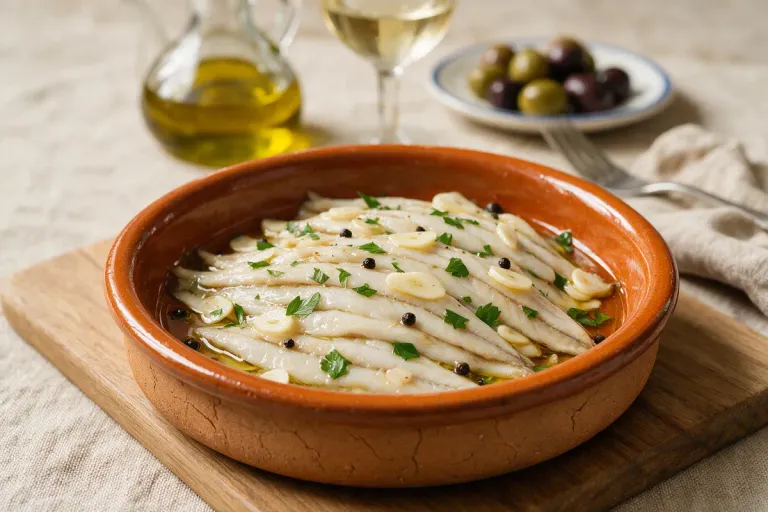
Boquerones are the same fish, handled fresh. Boquerones en vinagre are raw fillets marinated in vinegar, which turns them white, then dressed with garlic, parsley and olive oil. They are sharp and clean rather than deep and salty. Boquerones fritos, whole small anchovies dusted in flour and fried, are a standard in Andalusian bars, especially around Málaga.
On a menu, "anchoas" means cured and brown; "boquerones" means white and marinated, or fried. They are not interchangeable.
The Thai way: keep the liquid
Thai cooking uses the same small fish mostly as a seasoning. Nam pla, fish sauce, is made by packing small fish — commonly including anchovies, alongside other species such as herring or mackerel depending on the region — with salt in large vats or jars and leaving them to ferment for many months. The liquid that comes off is fish sauce. It goes into curries, stir-fries, soups and dipping sauces, and it sits on the table as prik nam pla, fish sauce with sliced chillies and often lime.
So where Spain keeps the fillet and throws away the brine, Thailand keeps the liquid. Both methods rely on salt to hold back spoilage while the fish's own enzymes break down protein into the savoury flavour both cuisines prize.
Thailand also has pla ra, a thicker fermented fish preparation used widely in Isan cooking, and kapi, a fermented shrimp paste. Spain's closest everyday equivalent is the anchovy itself, used as a flavour base: a fillet or two melted into a sauce or dressing does a similar job to a splash of fish sauce.
Spain's own fish-sauce history
Spain has made fish sauce before. In Roman times, the south of the Iberian peninsula was a major producer of garum, a fermented fish sauce traded across the Roman world. The ruins of Baelo Claudia, near Tarifa in Cádiz province, still show the stone vats used for salting fish. Garum disappeared from Spanish cooking long ago, but it means the gap between a Cantabrian anchovy and a Thai fish sauce is smaller than it looks.
Ordering tips for Thai diners
- If you like the depth of nam pla, order anchoas. They give you that savoury punch in a solid form.
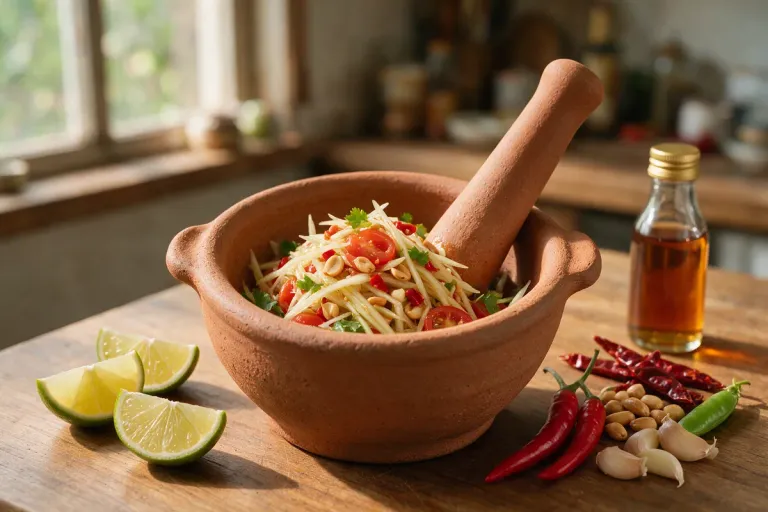
- If you like the brightness of lime-dressed salads such as som tam, try boquerones en vinagre. The vinegar gives a similar sharpness.
- Anchoas are salty on purpose. Eat them with bread, and don't add salt to anything else on the plate.
- Price is a clue. Hand-filleted Cantabrian anchovies are expensive to make, so a very cheap plate is probably a lesser product.
Where to try Spanish anchovies
These restaurants in our directory mention anchovies in their own listings:
- MoVida Bangkok on Sukhumvit Road, from chef Frank Camorra, lists Cantabrian anchoas among its refined tapas, alongside cecina and fideos negros. It opened in June 2025, and the listing advises booking ahead.
- Tapisco in The Hague serves modern tapas with Spanish and Portuguese influences; anchovies, squid, empanada and boneless Iberian ribs are on its list of typical products.
- Restaurante Guria in Mexico City is a contemporary Basque restaurant whose tapas include anchovies, Iberian and serrano ham, Manchego and croquetas.
For more on Spanish food in Thailand, see our guide to Spanish food in Bangkok.