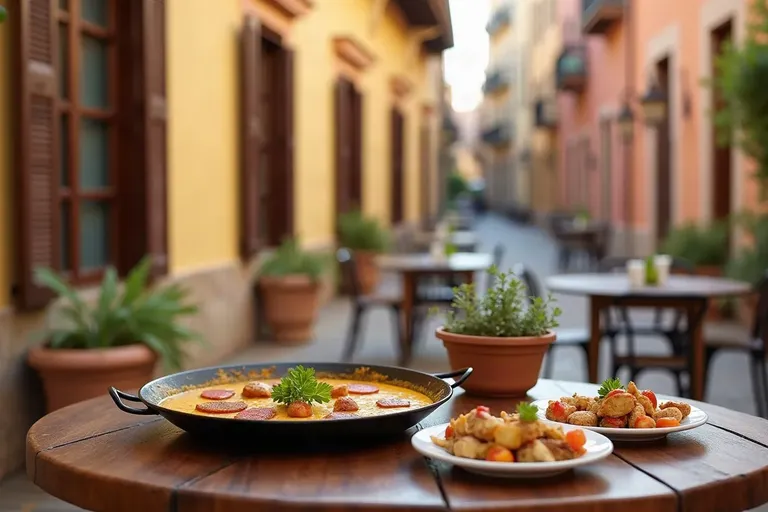
Oxtail is a cut that needs time. It is mostly bone, with meat wrapped around each joint and a lot of connective tissue that stays tough until it has cooked for hours. Once it gives, the meat comes away from the bone and the collagen makes the liquid rich and sticky. Spanish and Thai cooks both prize it, and both cook it slowly, but they end up in very different places: a thick wine sauce in Spain, a broth in Thailand.
Rabo de toro: the Spanish braise
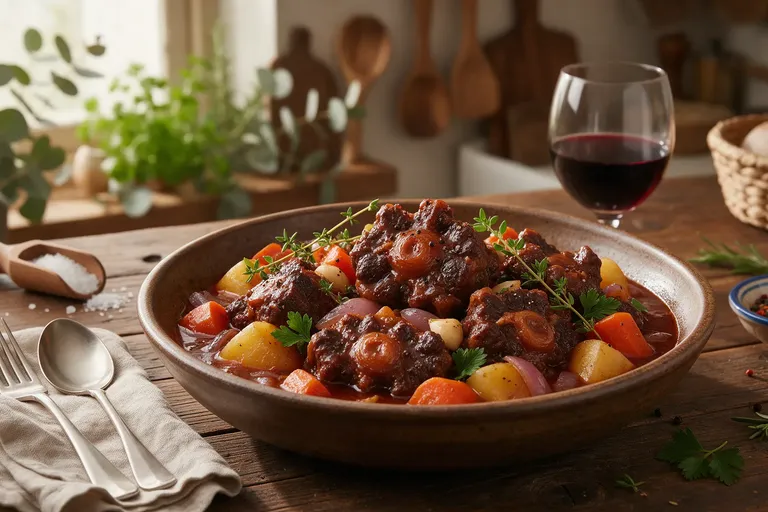
Rabo de toro means bull's tail. The dish is most closely associated with Córdoba, and the name comes from the tails of fighting bulls. Today most rabo de toro is made with ordinary beef oxtail, and some menus are honest about it and say rabo de vaca or rabo de ternera instead.
The method is a braise. The pieces are browned, then cooked slowly with onion, carrot, garlic and plenty of red wine until the meat is soft and the sauce has reduced to a dark, glossy coat. It is usually served as a main course with fried or mashed potatoes, and bread on the side for the sauce. Modern bars also use the meat as a filling for croquetas or small sandwiches. Our rabo de toro guide goes into how to order it.
Sup hang wua: the Thai soup
In Thailand oxtail usually arrives as soup. Sup hang wua (oxtail soup) is a dish closely tied to Thai Muslim cooks, and it is a regular on the menus of Thai Muslim restaurants. The oxtail is simmered for a long time into a broth, and the bowl typically comes with tomato, onion and fresh herbs. Lime and chilli are common seasonings, often added at the table.
It is eaten with rice, often as part of a shared meal rather than as a course on its own.
Same cut, different goals
Spain reduces the cooking liquid into a sauce that clings to the meat; Thailand keeps it as a broth you drink. Rabo de toro gets its depth from wine and a long reduction, while sup hang wua is usually brightened with lime and chilli. And on the plate, rabo de toro is a main course with potatoes and bread, where sup hang wua sits in the middle of the table with rice.
Neither dish works if it is rushed. In both, you want meat that slides off the bone.
Ordering tips
- In a Spanish restaurant, rabo de toro is usually a main course or a large ración. Order bread.
- If the menu says rabo de vaca or rabo de ternera, it is the same dish made with beef oxtail.
- If it comes with potatoes, it is fine to ask for extra sauce.
Where to try rabo de toro abroad
These venues list oxtail in their own records:
- La Encina, Bogotá: rabo de toro sits on a traditional menu with paella, cochinillo segoviano and callos a la madrileña.
- Casa Alejandro, Panama City: owner and chef Alejandro Pérez Barreiro's menu includes rabo de toro alongside cocido gallego and pulpo a la gallega.
- Huevos de Oro, São Paulo: oxtail (rabo de toro) is among the menu's dishes, with tortilla de patatas and Asturian cachopo.
- Alma Gitana, Villa de Leyva: a small family business whose record names oxtail as its great speciality.
For another beef comparison, read chuletón and suea rong hai.